

The Braveheart Effect
It all started with the author and scriptwriter Randall Wallace – yes, he came from Tennessee, in the USA, but his ancestors had their roots in Ireland and Scotland, and he first came across the story of William Wallace when he visited Scotland and saw the statue of him that guards the entrance to Edinburgh Castle, along with that of Robert the Bruce.
To research the story, he travelled through Scotland and England, visiting places associated with Wallace’s life. He also read as much as he could about him, and he used all of the information he gathered – along with his own imagination – for his fifth novel and the screenplay which followed – ‘Braveheart’.
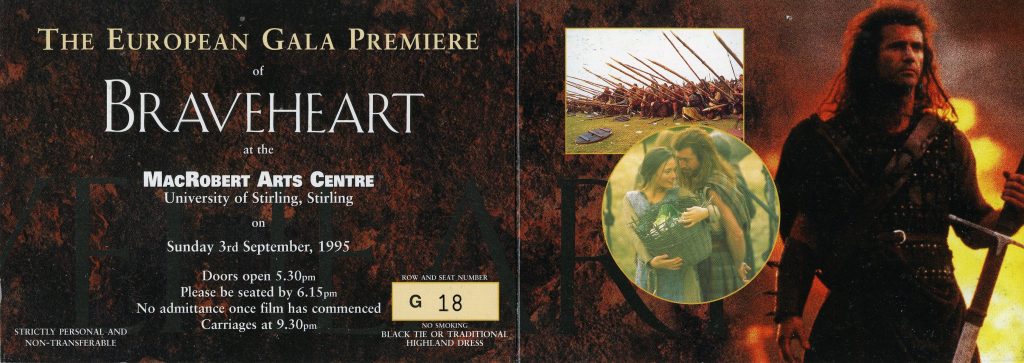
- The European premiere of the award-winning historical drama ‘Braveheart’ was held at The University of Stirling on Sunday 3rd September 1995.
- The premiere was attended by Mel Gibson, who produced and directed the film, as well as playing the leading role of Wallace. Other stars who attended the premiere were Catherine McCormack, and Angus MacFadyen, who played Robert, 17th Earl of Bruce.
- After the premiere, guests were taken to Stirling Castle for a private party, with a programme of entertainment including Scottish dancers and pipers.
- Braveheart won 5 Academy Awards in 1996, including ‘Best Picture’ and ‘Best Director’.
- Braveheart grossed £109 million at the box office, and it brought the story of William Wallace, depicted and portrayed as a Scottish hero, to the attention of audiences worldwide.
- On its opening weekend Braveheart grossed $9,938,276 in the United States, and in Scottish cinemas the film played for up to 8 months after the initial launch.
- The three-day “Braveheart Conference” at Stirling Castle attracted 167,000 visitors in 1996, compared with 66,000 in 1995.
The film which broke records – also broke the rules!
Braveheart sets out to tell the story of William Wallace, but the film has become something of a legend itself, just like the character who inspired it! That’s where it becomes interesting in terms of the economic impact which it has had over time.
You see – normally, film tourism is supposed to work like this. Blockbuster movies depict the most amazing places on the big screen – and when we see those places depicted, we want to go and see them for ourselves, we want to stand where famous actors have stood, put ourselves in their shoes.
For those who saw the film Braveheart – and who were captivated by the story, it was Wallace that captured their imaginations, it was Wallace who became the character they wanted to understand better, to know exactly who he was. And that is what brought them here, to Stirling, and to The National Wallace Monument.
- Prior to the launch of the film, annual visitor numbers to the Monument were in the region of 80,000 per annum.
- By 1998 they reached a record figure of 184,265.
- For the 10-year period from 1996 to 2005 the average annual number of visitors to the Monument was 135,000, and it has subsequently remained above the 100,000 level over subsequent years.
What has Braveheart meant for Stirling?
It was only after Wallace was executed that the impact of his achievements came to be recognised – and similarly – after Braveheart hit the big screen we can now appreciate the impact which it has had.
And to say that the impact was phenomenal is no exaggeration. The film has prompted at least 1 million visitors to come to Stirling – and they have spent at least £25m here in the city – in Stirling’s shops and restaurants, in its hotels and guesthouses, and in its outstanding visitor attractions.
That has supported local businesses, it has supported jobs, and it has enabled the operators of venues such as The National Wallace Monument to invest in their property, to invest in their services, and to provide a warm welcome to all those Braveheart fans who still make their way to Stirling every year.


