Scotland’s Year of Stories 2022
Part Three – The Battle of Stirling Bridge
Some stories in Scotland’s history are so firmly fixed in collective memory, passed down through the ages, that they became legendary.
These are the stories that can be recited in detail throughout each generation, the stories so celebrated that even the date can be recalled without prompting.
11th September 1297
This would be one of the most triumphant days in the story of medieval Scotland. It would be the day that William Wallace and Andrew de Moray faced their destiny, cementing their place among the greatest of heroes.
During the course of summer 1297, the two rebels had finally met and joined forces. The north east of Scotland continued to stubbornly resist English rule and Edward I had lost all patience with his own nobles.
Edward was distracted by events elsewhere, but instructed the Earl of Surrey, John de Warrene to return to Scotland and finally quash these last pockets of revolt. It was not a polite request. Warrene’s initial refusal fell on unsympathetic ears.
By early September, Wallace and Moray had marched south from Dundee to Stirling, eventually occupying the Abbey Craig. The undoubtedly numerically superior English army would arrive soon after, using Stirling Castle as a base.
A narrow wooden bridge
The outcome of this inevitable confrontation would rely on one simple feature of Stirling’s landscape: a single crossing point over the River Forth.
The then wooden Stirling Bridge was narrow, big enough only for men or horses to march two-abreast. It would take considerable time for a large army to cross.
But for those who wished to conquer the Highlands, there was little choice. Stirling Bridge had to be traversed and any opponents blocking the way crushed.
The two sides met in battle
There are many tales about how events unfolded on that September day in 1297. Some say that Warrene overslept and his men had to be called back, others state that the English mistakenly believed that Wallace and Moray wished to negotiate, only to be informed that this was false.
Regardless of the circumstances, Wallace and Moray watched closely as the English soldiers began to cross in earnest. From that point onward, the Scots simply had to wait patiently and hope that they were about to achieve a masterstroke in strategy, outmanoeuvring an overconfident enemy.
The final crossing for the English was a long, sluggish process. From their vantage point on the north bank of the river, Wallace and Moray continued to observe.
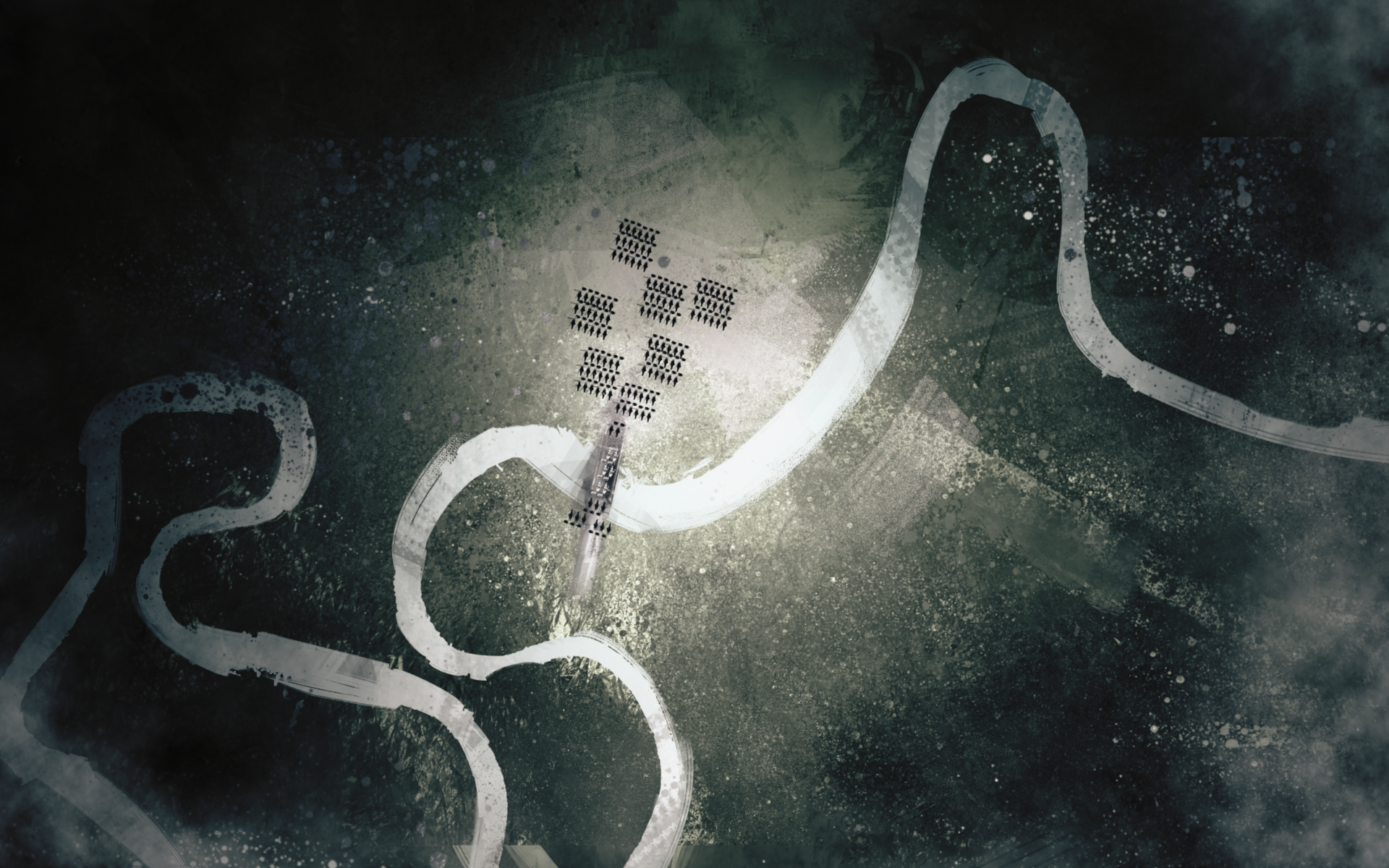
Eventually the trap was sprung. The Scots advanced in tightly packed schiltrons, driving the English army back toward the loop of the river. Men and horses were still crossing the narrow wooden bridge. The advantage of superior numbers was meaningless on this side of the river, the English were trapped and unable to make a hasty retreat. In short, this was mass slaughter.
Victory against all odds
The violence inflicted by the Scottish forces would not end there. The dramatic crescendo to this frenzied attack arrived with a loud crack, the splintering of wood and the cries of man and beast as the cold river waters swirled around them.
Stirling Bridge had collapsed. Whether it was sabotage by the Scots, destroyed by the English or simply collapsed under strain, the bridge would take many more fighters with it. Men and their horses became mired, weighed down by armour or thrashing limbs and drowned.
Bloody and brutal
Although lauded as a hero in subsequent centuries, William Wallace demonstrated that even the victorious underdog could be capable of cruelty.
In this era of violent unrest, there was little surprise that Wallace apparently disposed of a most hated individual in a way that would maximise his humiliation. Hugh de Cressingham was killed and a flayed from head to heel, a strip of his skin allegedly fashioned into a sword belt for the triumphant Wallace.
If this story needs a named villain, Cressingham would be the perfect candidate. He was appointed treasurer by Edward I therefore loathed by the Scots who saw Cressingham as a thief. But the much maligned treasurer was not particularly liked by his own side either.
The aftermath of the battle
The Scots on the other hand would suffer a much greater loss. Andrew de Moray was mortally injured, eventually dying of the wounds inflicted upon him by November 1297. Moray had paid the ultimate sacrifice in standing up for his belief that Scotland should be in control of its own destiny, and not ruled by Edward I.
As for William Wallace, there would be a more twists to come within his story. But in his immediate future, Wallace honoured his fallen comrade and friend, continuing to issue correspondence in both names.
Such letters were lost to time but the Lübeck letter survived, showing that Wallace wished to extend the hand of friendship to other European countries, stating that Scotland had won back its status as an independent kingdom and wished to trade.
Wallace’s story and indeed Scotland’s story would continue, not the least because Stirling Bridge had severely wounded Edward’s pride. Retaliation, and a long-standing grudge against Wallace, was unfortunately inevitable.
But for now Wallace, Moray and even Stirling Bridge had been assured of their place among Scotland’s stories.
Click here to read more about The Battle of Stirling Bridge.
Talking points…
- What makes the Battle of Stirling Bridge such a great story? Think of aspects such as the likelihood that Wallace and Moray’s forces were vastly outnumbered, is this a classic underdog story?
- What do you think John de Warrene was thinking? Do you think he was certain this would be a victory for the English army regardless of the circumstances?
- How do you think a solider on the side of Wallace and Moray was feeling? Do you imagine you would know the Scots were outnumbered and therefore feel hopeless? Or do you believe that Wallace and Moray inspired a level of self-belief that would completely override any fears?
- Wallace’s treatment of Hugh de Cressingham’s body shows us that even those we consider heroes within our stories are capable of committing acts that we would consider disproportionate or violent. Do you feel that this is an example of how it is impossible for real people, even those deemed good or heroic, to avoid violence completely, especially at times of war?
- Stirling Bridge is an example of triumph in the face of adversity but also a story centred on one of the darker aspects of humanity (war) – how do stories such as these make you feel? Does a story need to be wholly good to be entertaining? And how do you feel about historical fact used as a basis for entertainment?
Continue reading to find out more…
- Part One – William Wallace
- Part Two – Andrew de Moray
- Part Three – The Battle of Stirling Bridge